2026 Service Industry Trends: What Every Contractor Needs to Know to Stay Competitive
May 5
8 min read
Updated: Aug 20
From AI adoption reaching critical mass to a workforce crisis reshaping operations the forces defining the contractor landscape this year, and what you can do about each one.

At ProjectsForce 360°, we talk to contractors every day from growing single trade operations to established multi-trade businesses managing hundreds of jobs a month. The message we're hearing across the board in 2026 is clear: the industry is changing faster than it ever has, and the contractors who adapt deliberately are pulling ahead of those who don't.
Whether you run an HVAC company, manage a flooring installation crew, oversee plumbing operations, or coordinate multi trade projects, the pressures converging right now labor scarcity, surging costs, accelerating technology, and evolving customer expectations demand more than just hard work. They demand operational clarity.
Here are the seven trends reshaping the service industry this year, and what you can do to turn each one into an advantage.
TREND 01
The Labor Shortage Has Become a Structural Crisis
This isn't a seasonal hiring headache anymore. The construction and service industry needs an estimated 349,000 net new workers in 2026 just to keep pace with current demand a figure projected to climb to 456,000 in 2027. That's on top of normal replacement hiring.
72% of contractors report difficulty hiring qualified workers | 40% of skilled tradespeople are now over age 45 |
The drivers are deeply structural. A wave of experienced workers is reaching retirement age roughly one in five construction workers is now 55 or older. Meanwhile, the pipeline of younger talent isn't keeping up, and immigration enforcement actions have compounded the problem, with nearly a third of construction firms reporting some level of workforce disruption in the past six months.
For smaller contractors, the squeeze is even tighter. Small remodeling firms report nearly double the hiring difficulty of larger companies, because bigger operations can offer more competitive pay, benefits, and consistent work schedules.
WHAT TO DO ABOUT IT
Stop treating hiring as a reactive scramble and start treating it as a system. Build apprenticeship pipelines, invest in training programs, and streamline your interview to offer timeline. Equally important: focus on retention. When your operations run smoothly when technicians aren't held up by scheduling confusion, missing information, or billing delays people want to stay. A well run operation is one of the strongest retention tools you have.
TREND 02
AI Adoption Has Reached a Tipping Point

For years, artificial intelligence in contracting felt theoretical something the big players experimented with while everyone else watched. That era is over. According to a 2026 industry survey of more than 1,000 commercial contractors, 38% now report measurable business results from AI, more than doubling the 17% who said the same just a year earlier.
38%
of contractors now see measurable results from AI up from 17% in 2025
The applications driving this aren't futuristic abstractions. Contractors are using AI for cost estimating, bid management, optimized scheduling, and predictive maintenance. Field service companies are deploying AI to match technician skills and location with job urgency, reducing delays and rescheduling. IoT sensors paired with AI analytics are monitoring equipment in real time, catching failures before they become emergency calls.
At ProjectsForce 360°, we've built AI-powered scheduling directly into our platform analyzing weather patterns, job requirements, and team availability to recommend the best dates for projects automatically. It's the kind of practical, everyday AI that frees your team to focus on execution instead of logistics.
WHAT TO DO ABOUT IT
You don't need to overhaul everything at once. Start with one high friction area scheduling, estimating, or customer follow-up and pilot an AI-assisted tool. The goal isn't to replace people; it's to make your existing team faster and more accurate. Contractors who wait another year to experiment will find themselves competing against firms that are already running leaner.
TREND 03
Margin Protection Has Replaced Revenue Growth as the Top Priority
For the first time in several years, the conversation among contractors has fundamentally shifted. The dominant strategic focus in 2026 isn't growth it's profitability. Backlogs are healthy: over three quarters of commercial contractors report at least nine months of secured work, and 41% have more than a year of projects lined up. The problem isn't finding work. It's making money on the work you already have.
" The most critical strategic opportunity for 2026 is the consolidation of fragmented technology into a single, unified system."
— Raffi Elchemmas, former Executive Director of Safety, Health & Risk Management, MCAA
Rising labor costs, higher material prices, and overhead creep are eating into margins. A full 71% of contractors reported increased wages compared to the previous year. The smartest operators are responding by pricing based on actual costs rather than what competitors charge, focusing on higher margin service and replacement jobs, and investing in maintenance agreements that stabilize revenue streams.
Timely billing has emerged as one of the most overlooked levers for profitability 57% of contractors now identify it as a key factor in protecting their bottom line. When your system tracks every job from lead to payment in one connected workflow, nothing slips through the cracks.
WHAT TO DO ABOUT IT
Audit your true job costs ruthlessly. Know your numbers on every project not just after it's done, but while it's in progress. Invest in systems that give you real time visibility into labor hours, material costs, and change orders. And stop underpricing to win volume. In 2026, the contractors who thrive will be the ones disciplined enough to say no to unprofitable work.
TREND 04
Technology Fragmentation Is Quietly Killing Your Margins

Here's a number that should concern every contractor: only 20% of commercial service businesses have consolidated their operations onto a single technology platform. The rest are juggling two, three, four, or more disconnected systems separate tools for accounting, project management, estimating, time tracking, and bid management that rarely communicate with each other.
80% of contractors still run on fragmented, disconnected tech stacks | 25% rely on four to six separate software systems |
Every handoff between those systems is a place where data gets lost, decisions get delayed, and margin slips away. When your controller is reconciling timesheets, purchase orders, and subcontractor invoices across multiple platforms, a project that went over budget six weeks ago doesn't surface until it's too late to fix.
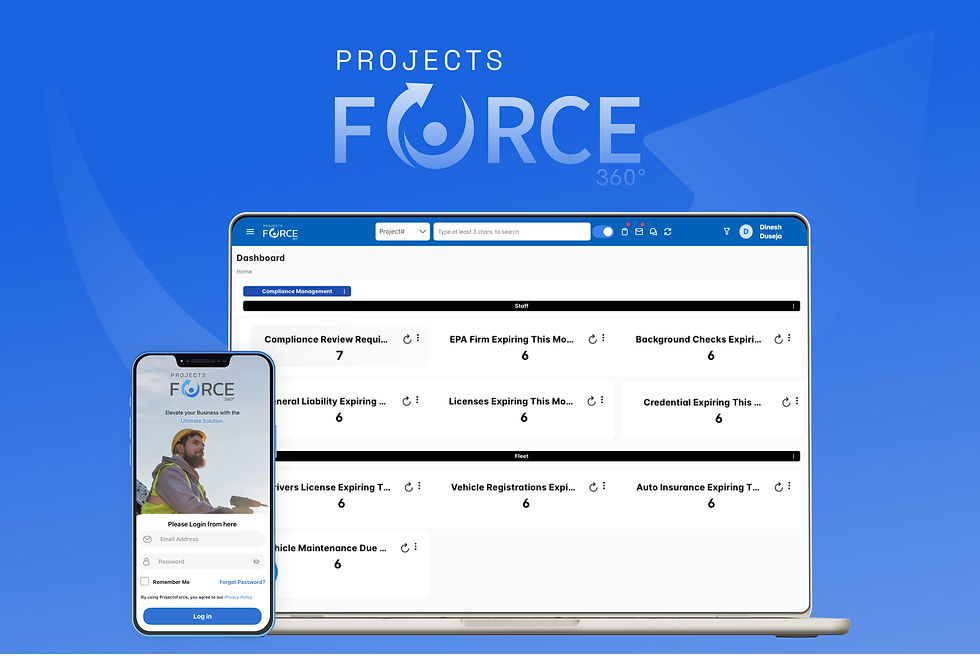
This is exactly the problem ProjectsForce 360° was built to solve. From lead capture to scheduling, team management, inventory tracking, document compliance, and payments everything lives in one system. No duct taping tools together, no re-keying data, no blind spots. When your sales pipeline, job status, crew assignments, and financials are connected, you make better decisions faster.
WHAT TO DO ABOUT IT
Map out every piece of software your team touches in a given week. Identify where data gets re-entered, where reports lag, and where communication breaks down between field and office. Then prioritize consolidation with a clear roadmap toward fewer handoffs and real time visibility across your operation.
TREND 05
Customer Expectations Have Permanently Shifted
Today's homeowners and commercial clients don't compare your service to other contractors they compare it to every other digital experience in their lives. They expect online booking, real time arrival windows, transparent pricing, and frictionless communication. And they increasingly expect financing options that make large projects feel manageable.
The perception gap between contractors and their customers is a growing tension. More than half of remodeling contractors say homeowners only somewhat understand the value of their work, while nearly one in ten say homeowners largely undervalue contractor services. Kitchen and bath remodelers feel this most acutely, with over three quarters reporting that their work is underappreciated.
Meanwhile, contractors who offer flexible financing are seeing meaningful results. Low monthly payment options are outperforming same as cash offers in the current climate, helping customers commit to projects they might otherwise postpone.
WHAT TO DO ABOUT IT
Bridge the value gap through education, not argument. Develop clear communication around what quality work costs and why. Offer financing proactively don't wait for the customer to ask. And invest in the digital touchpoints that define the modern customer experience: automated scheduling, real time job updates, and a seamless path from first inquiry to final payment.
TREND 06
The Back Office Is the New Competitive Battleground

When most contractors think about competitive advantage, they think about field operations better technicians, faster response times, higher quality work. All of that matters. But the companies pulling ahead in 2026 are the ones who've realized that operational bottlenecks in the office are silently killing their growth.
Dispatch backlogs, invoicing delays, missed follow-ups, scheduling errors these administrative failures ripple outward, slowing down even the best field teams. One electrical contractor managed to compress invoicing delays from over a week down to same day by restructuring back office operations. That kind of improvement directly impacts cash flow, customer satisfaction, and capacity to take on more work.
We built ProjectsForce 360° around this insight. When your entire operation from the first lead to the final payment runs through one connected platform, your office team isn't buried in reconciliation and manual data entry. They're managing exceptions, not process. That's the difference between an office that holds your business back and one that accelerates it.
WHAT TO DO ABOUT IT
Treat your office operations with the same rigor you apply to field work. Measure the time from job completion to invoice. Track how many calls go unanswered. Identify where your best technicians are being held back by administrative bottlenecks. Then invest in the systems needed to fix those gaps the ROI is often faster than any field side improvement.
TREND 07
Sustainability and Smart Home Integration Are Revenue Opportunities

Regulatory pressure and consumer demand are converging to make sustainability a genuine profit center for forward thinking contractors. Refrigerant reclamation, energy efficient system upgrades, and smart home technology installations represent expanding revenue streams that also carry higher margins than traditional service work.
Investments in smart technology have grown substantially, and the trend accelerated through the pandemic as homeowners embraced touchless fixtures, connected thermostats, and voice controlled home systems. Contractors who position themselves as experts in these areas capable of installing, integrating, and maintaining smart home ecosystems can command premium pricing and build deeper, longer term customer relationships through ongoing service agreements.
The rebate and incentive landscape is another underutilized opportunity. Contractors who understand available federal, state, and utility programs can present more attractive proposals, effectively lowering the perceived cost of upgrades while protecting their own margins.
WHAT TO DO ABOUT IT
Train your team to sell and install energy efficient and connected solutions, not just traditional equipment. Build a knowledge base around available rebates and incentives so every proposal includes the full picture. And develop maintenance agreement offerings around smart home systems recurring revenue is the most valuable kind of revenue.
Adapt Deliberately or Get Left Behind
Despite every challenge outlined above, contractor optimism remains remarkably strong 77% of residential remodeling contractors report a positive outlook for 2026. That confidence isn't naïve. It reflects the reality that demand for skilled service work isn't going anywhere. Homes still need heating. Buildings still need wiring. Floors still need installing.
But optimism without operational clarity is just hope. The contractors who will look back on 2026 as a breakthrough year are the ones making deliberate investments right now: consolidating their technology, protecting their margins, building workforce pipelines, and meeting customers where they are.
That's what we're focused on at ProjectsForce 360° giving contractors one connected system to manage their entire operation, from lead to payment, so they can spend less time wrestling with tools and more time doing what they do best: delivering great work.
Ready to Run Your Operation on One Platform?
ProjectsForce 360° connects your sales, scheduling, teams, inventory, and payments so nothing falls through the cracks.



Comments